Oxus Treasure Hoards
Discovered between 1877 and 1880 near the banks of the ancient Oxus River (modern Amu Darya) near Takht-i Kuwad in Tajikistan, the Oxus Treasure represents the single most important corpus of Achaemenid Persian metalwork known to modern archaeology. Comprising approximately 180 gold and silver vessels, statuettes, torcs, and over two hundred coins spanning the sixth to second centuries BCE, this hoard preserves the material zenith of Persian imperial art fused with the nomadic animal aesthetic of the Eurasian steppes.
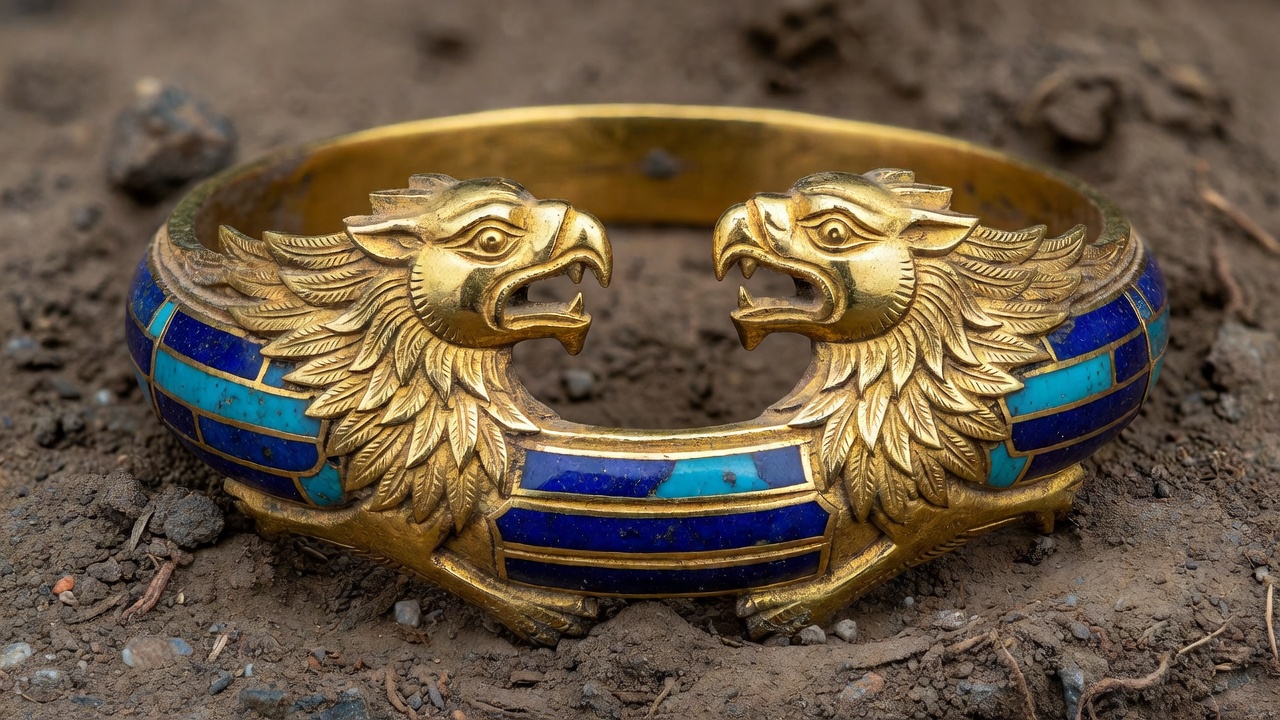
The Griffin Armlets and Cloisonné Enameling
Among the most iconic artifacts within the hoard are a pair of penannular gold armlets culminating in dynamic winged griffins. These mythical hybrids—combining the horned head of an ibex, lion claws, and avian wings—were cast in solid gold via multi-piece investment casting and soldered with precision seams.
Deep hollowed cells (cloisons) along the necks, wings, and flanks were once inlaid with vibrant turquoise from Nishapur, carnelian, and colored vitreous paste. While the stones were largely looted during early rediscovery, the gold structural armatures preserve the fluid energy of imperial Persian court jewelry.
The Miniature Golden Chariot
Another masterwork from the hoard is a seven-centimeter gold miniature model of a four-horse chariot. Driven by a seated charioteer in Persian attire accompanied by a standing dignitary, the harness straps, linchpins, wheel spokes, and horse bridles are rendered with micro-metallurgical precision.
Convergence of Empires
The Oxus hoard does not merely reflect Persian statecraft; it illuminates the multi-cultural highway of Bactria. Here, Mediterranean Greek drapery folds on miniature statuettes intersect with Scythian coiled predators and Vedic decorative motifs. This metallurgical cross-pollination illustrates how ancient trade corridors acted not merely as passages of commerce, but as dynamic synthesizers of global aesthetic technologies.