Indus Drainage Networks
While the civilizations of Egypt and Mesopotamia channeled monumental energy into soaring tombs and palatial monuments, the Indus Valley Civilization (c. 2600–1900 BCE) achieved an unmatched pinnacle in public health and urban sanitation. Covering over one million square kilometers across modern Pakistan and northwest India, Harappan urbanism was founded on uncompromising standardization and civil engineering.
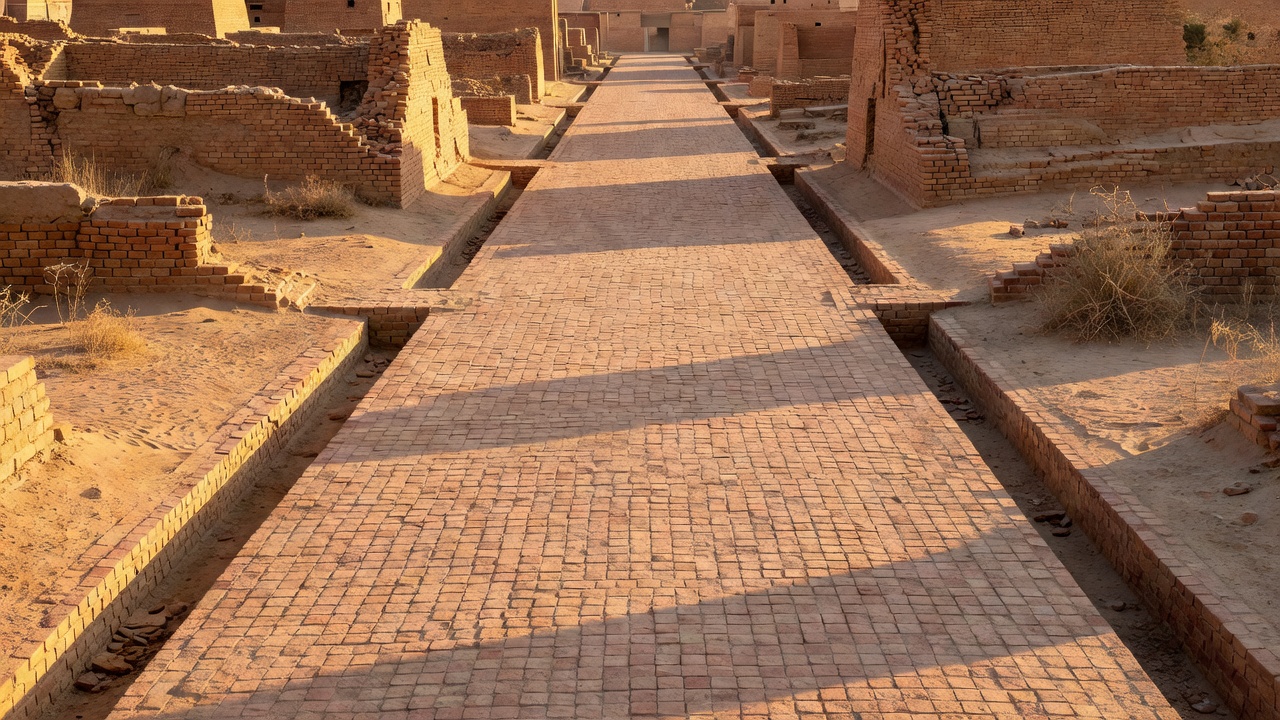
The Sacred Standard: The 1:2:4 Brick Ratio
From the coastal port of Lothal on the Arabian Sea to the northern foothills at Shortugai, every excavated Harappan community manufactured building bricks adhering strictly to an exact dimensional proportion: 1 unit of thickness to 2 units of width to 4 units of length (commonly 7 × 14 × 28 cm). This geometric ratio ensured maximum structural bonding strength in alternating courses.
Where flood waters threatened foundations, city planners deployed kiln-baked bricks bonded with impermeable bitumen and gypsum mortar, reserving sun-dried mud bricks solely for interior partitions and elevated citadel platforms.
Hydraulic Sanitation and Wastewater Channels
The urban planning of Mohenjo-daro and Harappa incorporated an integrated dual-stream plumbing network. Domestic wastewater from private bathrooms flowed through terra-cotta conduits integrated directly into exterior house walls. These emptied into covered street-level drainage channels constructed of chisel-dressed masonry.
Crucially, Indus engineers understood settling physics. Street drains featured removable stone inspection traps and silt collection sumps at regular intervals, preventing sediment blockages and allowing city sanitation workers to clear debris. The street channels were completely roofed over with stone slabs to suppress odors and vector-borne pathogens—an urban sanitation feat unmatched until the nineteenth century.
Water Conservation at Dholavira
In the arid landscape of the Rann of Kutch, the fortress city of Dholavira pioneered monumental rainwater harvesting. Lacking perennial rivers, Harappan engineers carved sixteen massive bedrock reservoirs linked by stepped aqueducts. These stone cisterns collected monsoon surface runoff from the ephemeral Manhar and Mansar torrents, capable of holding over 250,000 cubic meters of potable water to sustain the populace through prolonged droughts.