Andes Stone Alignments
Perched thousands of meters above sea level across the jagged spine of the South American Andes, civilizations including the Tiwanaku, Wari, and Inca developed stone-working techniques that remain unmatched in structural durability. Rather than relying upon lime mortars or tensile cement, Andean stonemasons solved the existential threat of violent Pacific tectonic activity through polygonal friction joints.
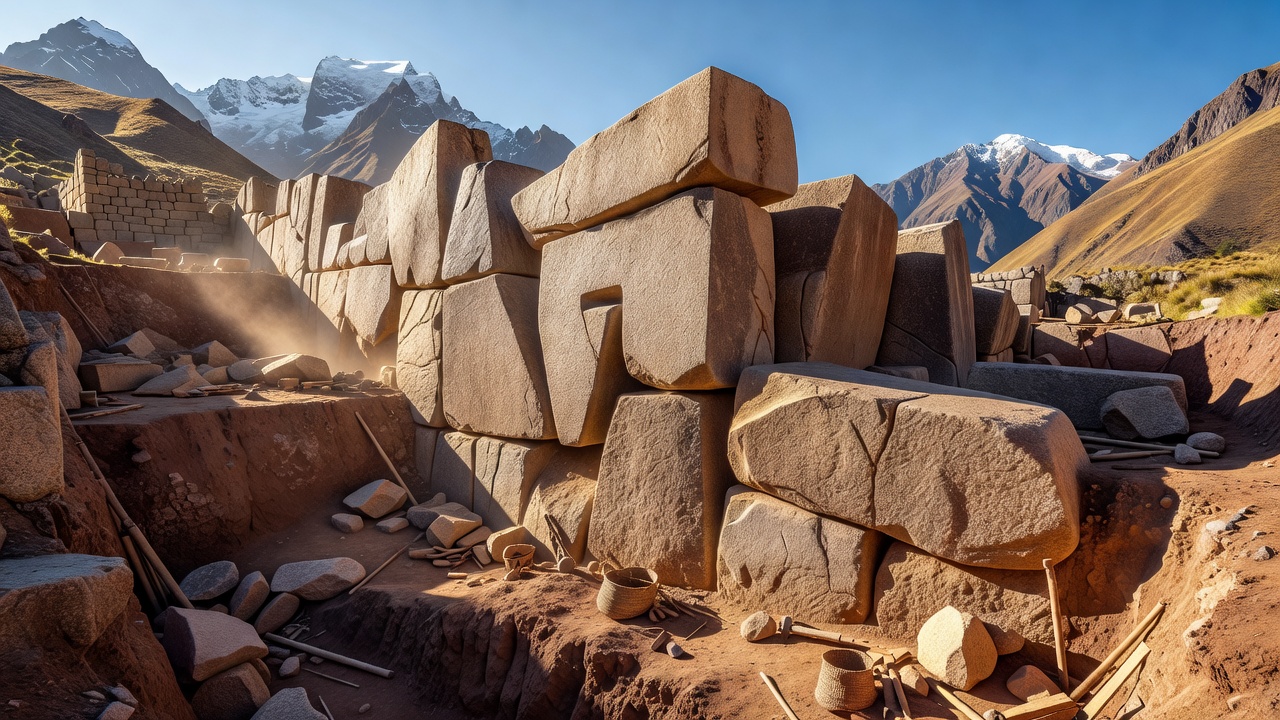
Seismic Kinetic Joinery
In high-magnitude earthquakes, rigid mortared structures fracture and crumble as shear stresses concentrate along brittle joint lines. Andean master builders anticipated this failure mode. At Sacsayhuaman and Machu Picchu, blocks weighing in excess of seventy metric tons were shaped with multi-faceted polygonal margins, bevel-carved edges, and concave-to-convex interlocking bedding planes.
During a tremor, these massive blocks shift momentarily upon their beds, dissipating seismic energy through micro-movements, before sliding back into their original gravitational alignment. Centurial colonial structures in Cusco built on Spanish foundations collapsed repeatedly in earthquakes (1650 and 1950), while the underlying Inca terraces beneath remained completely undisturbed.
Tiwanaku and Pumapunku: Bronze Clamps and Precision Rebates
On the high Bolivian Altiplano near Lake Titicaca, the monumental center of Tiwanaku (c. 600–1000 CE) exhibits an earlier technological sophistication. At Pumapunku, red sandstone slabs and dense volcanic andesite blocks feature precision-milled right-angle interior corners and uniform T-shaped socket depressions.
| Complex Location | Lithic Material | Average Mass | Connection Methodology |
|---|---|---|---|
| Pumapunku Platform | Red Sandstone & Andesite | 20 to 130 Metric Tons | Cast copper-arsenic-nickel alloy I-clamps |
| Sacsayhuaman Zigzag Wall | Yucay Limestone | 50 to 120 Metric Tons | Mortarless 3D polygonal joint matching |
| Ollantaytambo Fortress | Pink Granite | 40 to 65 Metric Tons | Fitted spacer stones with polished seams |
Spectrographic analysis of metallic residue trapped within these stone sockets proves that Tiwanaku metallurgists poured molten copper-arsenic-nickel ternary bronze clamps directly into the cold stone on-site. As the molten bronze cooled and contracted, it pulled the adjacent andesite megaliths tightly together with mechanical tension.
Quarry Transport and Percussive Dressing
The realization of these stone complexes required immense logistical coordination. Stones from the Kachiqhata quarry across the Vilcanota River were transported downhill across steep alluvial fans, dragged across the riverbed using heavy braided maguey-fiber ropes and log rollers, and hoisted up steep ramps to the terrace terraces of Ollantaytambo. Through patient percussive attrition with stone mauls, Andean builders achieved joins so tight that a sheet of parchment cannot penetrate the interface.